
Last Updated on September 30, 2026 by Helena Akter
For most herbal teas, water should be between 200°F and 212°F, or about 93°C to 100°C. This hotter range works well for common herbal infusions such as peppermint, hibiscus, rooibos, ginger, and many fruit or spice blends.
Most herbal teas are made from flowers, leaves, roots, bark, seeds, or dried fruit.
The ideal temperature can still vary depending on what is in your tea. Soft flowers and aromatic leaves may taste better with water slightly below boiling, while roots, bark, seeds, and dried fruit usually benefit from hotter water and a longer steep.
If you are using a packaged herbal tea, check the brewing instructions first because the ingredients and recommended preparation can vary by blend.
In this guide, you will find practical water temperatures and steeping times for popular herbal teas, along with simple tips for getting a stronger, smoother cup without guessing.
Key Takeaways
- Most herbal teas: Start with water around 200°F to 212°F, or 93°C to 100°C.
- Flowers and aromatic leaves: Chamomile, lemon balm, lavender, and similar herbs can usually be brewed with hot or near boiling water, although slightly cooler water may produce a softer flavor.
- Roots, bark, and spices: Ginger, cinnamon, dandelion root, and other dense ingredients generally need very hot water and often benefit from longer steeping or gentle simmering.
- Steeping time matters too: Most herbal teas need about 5 to 10 minutes. Dense roots and spices may require longer.
- Blends need special attention: If an herbal blend also contains green, white, black, or oolong tea, follow the temperature recommendation for the actual tea leaves in the blend.
- Package directions come first: Herbal products vary in cut size, ingredients, and concentration, so the manufacturer’s instructions are the best starting point when they are available.
What Temperature Should Water Be for Herbal Tea?
For most herbal teas, a good starting point is 200°F to 212°F, or 93°C to 100°C. Many herbal infusions are made from flowers, leaves, roots, bark, seeds, or dried fruit that handle very hot water well.
The best temperature depends on the ingredients. Peppermint, hibiscus, rooibos, and many herbal blends can be prepared with freshly boiled water. Denser ingredients such as ginger root, cinnamon, and other spices may also need a longer steep or gentle simmer to develop a fuller flavor.
Delicate flowers can be more flexible. Water slightly below boiling may produce a softer flavor and aroma, so you can adjust the temperature and steeping time according to your preference.
If your herbal blend contains true tea leaves from Camellia sinensis, such as green tea, white tea, black tea, or oolong tea, follow the brewing instructions for those tea leaves instead of automatically using boiling water. They have different temperature requirements from most pure herbal infusions.
If you are still learning how to brew herbal tea, start with the recommended temperature and then adjust the steeping time to suit your taste.
Why Water Temperature is Important When Brewing Tea?
Water temperature affects how quickly flavor, aroma, color, and soluble compounds move from plant material into the water.
If the water is too cool, some herbal teas can taste weak even after several minutes. This is particularly noticeable with roots, bark, spices, and dried fruit.
Hotter water generally speeds extraction, but more heat is not always better for flavor. Delicate flowers and highly aromatic herbs can sometimes produce a softer flavor when brewed slightly below boiling.
Temperature also needs to be considered together with steeping time and the amount of herb used. A stronger cup can often be made by adding more herbs or steeping longer rather than simply increasing the temperature.
For packaged herbal tea, the brewing instructions on the label provide a useful starting point because they are designed for that particular blend.
Herbal Tea Temperature and Steeping Chart
| Herbal Tea | Water Temperature | Steeping Time |
|---|---|---|
| Chamomile | 200°F to 212°F | 5 to 7 minutes |
| Ginger | 200°F to 212°F | 7 to 12 minutes |
| Dandelion Leaf | 200°F to 212°F | 5 to 10 minutes |
| Dandelion Root | Around 212°F | 10 to 15 minutes |
| Cardamom | Around 212°F | 5 to 10 minutes |
| Hibiscus | 200°F to 212°F | 5 to 10 minutes |
| Lemon Balm | 195°F to 205°F | 5 to 7 minutes |
| Peppermint | 200°F to 212°F | 3 to 7 minutes |
| Raspberry Leaf | 200°F to 212°F | 5 to 10 minutes |
| Rooibos | 200°F to 212°F | 5 to 10 minutes |
These temperatures and steeping times are practical starting points. The best method can vary depending on whether the herbs are fresh or dried, how finely they are cut, how much you use, and the other ingredients in the blend. If your tea comes with brewing instructions, follow those first.
If you are brewing with fresh herbs, you may need to adjust the amount you use because fresh and dried herbs can produce different strengths.
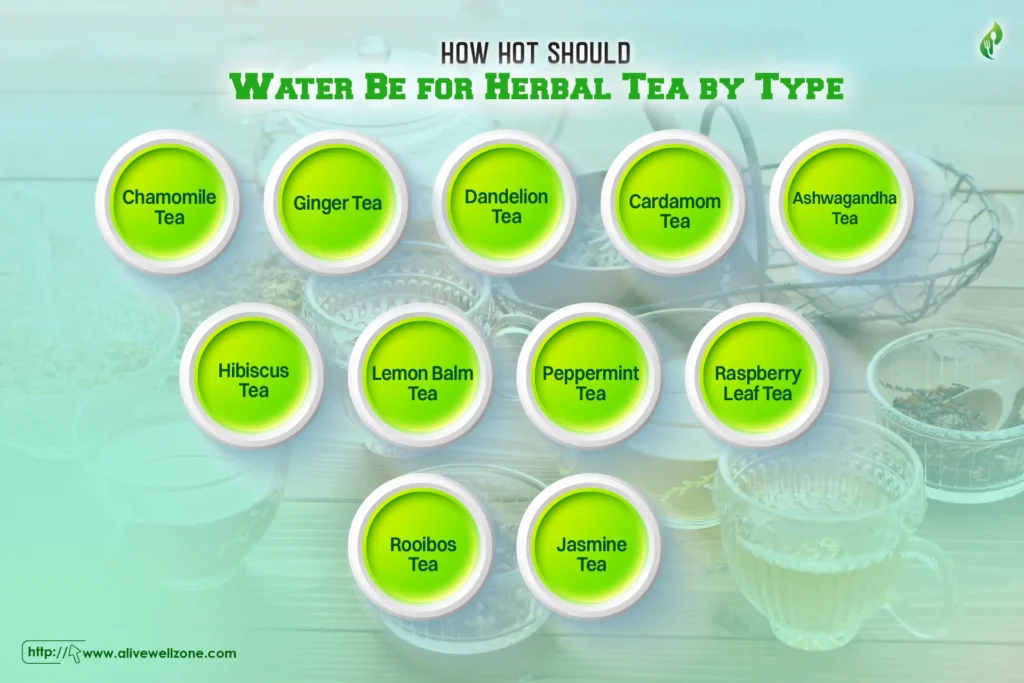
How Hot Should Water Be for Herbal Tea by Type
Let’s now see the best water temperature for different types of herbal tea.
Water Temperature for Chamomile Tea
Chamomile can be brewed with hot or freshly boiled water. A practical starting range is 200°F to 212°F, followed by a steep of around 5 to 7 minutes.
If you find the flavour too strong or slightly bitter, try shortening the steep before dramatically lowering the water temperature. You can also experiment with water just below boiling for a softer floral cup.
Covering the cup while the chamomile steeps can help retain more of its aroma.
Water Temperature for Ginger Tea
Ginger handles high temperatures well. Use water close to 212°F or 100°C for fresh or dried ginger.
For thinly sliced ginger, start with a steep of about 7 to 10 minutes. If you are using larger or tougher pieces, gently simmering the ginger for 10 to 15 minutes can produce a stronger flavor.
There is no need to worry about reaching one exact temperature. For ginger tea, freshly boiled water is a practical starting point.
Water Temperature for Dandelion Tea
The best brewing method depends on whether you are using dandelion leaves or dandelion root.
For dandelion leaf tea, use hot or freshly boiled water and steep for about 5 to 10 minutes.
Dandelion root is denser and usually needs more extraction time. Pour boiling water over the root and allow it to steep longer, or gently simmer it if the product instructions recommend a decoction.
Because roasted dandelion root, raw root, loose leaf, and tea bags can all be prepared differently, check the package directions when possible.
Water Temperature for Cardamom Tea
Cardamom is a spice, so it can handle boiling water well. Start with water around 212°F or 100°C.
Lightly crushing whole cardamom pods before brewing can help expose more of the aromatic seeds to the water. Steep for about 5 to 10 minutes, depending on how strong you want the flavor.
If the cardamom is part of a blend containing black, green, or another true tea, use the brewing instructions for the complete blend rather than the cardamom alone.
Water Temperature for Ashwagandha Tea
Ashwagandha tea is commonly prepared from the root, which is denser than leaves or flowers. Hot or boiling water is therefore a practical starting point.
Preparation can vary significantly between powdered root, cut root, tea bags, and commercial blends. Follow the instructions supplied with the product, particularly when the manufacturer specifies an amount and brewing time.
If you take medication, are pregnant, or have a medical condition, remember that herbal products are not automatically suitable for everyone. Speak with an appropriate healthcare professional if you are unsure whether ashwagandha is appropriate for you.
Water Temperature for Hibiscus Tea
Hibiscus works well with very hot water. Start with water between 200°F and 212°F, then steep for approximately 5 to 10 minutes.
A longer steep usually produces a deeper red color and a stronger tart flavor. If the tea becomes too sharp for your taste, reduce the steeping time rather than relying on cooler water.
Hibiscus can also be prepared as a cold infusion, so boiling water is not the only way to make it. For a traditional hot cup, however, near boiling or boiling water is a reliable starting point.
Water Temperature for Lemon Balm Tea
For lemon balm, start with water around 195°F to 205°F, or slightly below a full boil. Steep the leaves for about 5 to 7 minutes.
Keep the cup or teapot covered while the leaves steep. This is especially useful with aromatic herbs because much of their character comes from volatile compounds responsible for their fragrance.
If you are using fresh lemon balm rather than dried leaves, you may need a larger quantity to produce the same intensity of flavor.
Water Temperature for Peppermint Tea
Peppermint can be brewed with freshly boiled water at about 212°F or 100°C.
Steep for around 3 to 7 minutes, depending on the strength you prefer. Covering the cup while it steeps can help retain the minty aroma.
If your peppermint is blended with green tea or another tea that is sensitive to high temperatures, follow the brewing instructions for the complete blend instead.
Water Temperature for Raspberry Leaf Tea
For raspberry leaf tea, use hot or freshly boiled water, generally around 200°F to 212°F. Allow it to steep for approximately 5 to 10 minutes.
Commercial raspberry leaf products can vary, so use the package instructions when they provide a specific brewing time.
Raspberry leaf is also used for reasons beyond flavor, particularly during pregnancy. If you are considering it for a health related purpose, discuss its use with an appropriate healthcare professional instead of relying on brewing advice alone.
Water Temperature for Rooibos Tea
Rooibos handles high temperatures well. Use water between 200°F and 212°F, or approximately 93°C to 100°C.
Steep for about 5 to 10 minutes. Rooibos is generally forgiving, so you can extend the steep if you prefer a stronger cup.
Because rooibos is an herbal infusion rather than a tea made from Camellia sinensis, it does not need the lower brewing temperatures commonly recommended for delicate green or white teas.
Water Temperature for Jasmine Tea
The correct temperature for jasmine tea depends on its base tea.
Most jasmine teas are made by scenting green tea leaves with jasmine flowers. For a jasmine green tea, follow the temperature recommended for green tea, which is usually considerably cooler than boiling water.
Jasmine white tea should be brewed according to the instructions for the white tea base.
If you have an herbal blend without caffeine made primarily from jasmine flowers and other herbs, follow the brewing instructions provided for that specific product.
Always check the ingredient list before deciding on the temperature. The word “jasmine” alone does not tell you how the tea should be brewed.
If you are choosing jasmine or other herbal blends because of caffeine, check the ingredient list carefully because some blends contain green, black, or other true teas.
Does Herbal Tea Need Boiling Water?
Most herbal teas can be made with boiling or near boiling water, especially teas containing roots, bark, spices, dried fruit, rooibos, peppermint, or hibiscus.
However, boiling water is not a universal rule. Delicate flowers may taste better slightly below boiling, while blends containing green or white tea usually require lower temperatures.
The simplest approach is to check the ingredients first. If the blend contains only robust herbs, freshly boiled water is usually appropriate. If it contains true tea leaves, follow the brewing temperature recommended for those leaves.
What if You Do Not Have a Tea Thermometer?
You do not need a thermometer to make good herbal tea.
For most herbal infusions, bring fresh water to a boil and pour it over the herbs soon afterward.
If you want slightly cooler water for delicate flowers, let the kettle rest briefly after boiling before pouring.
For temperature sensitive blends containing green or white tea, follow the package instructions because estimating lower temperatures by waiting for a fixed number of minutes is not always reliable. Room temperature, kettle design, water volume, and the container can all affect how quickly the water cools.
Why Does My Herbal Tea Taste Weak or Bitter?
If your herbal tea tastes weak, water temperature may be only part of the problem. Try using a little more herb, extending the steeping time, or covering the cup while it brews.
Roots, bark, seeds, spices, and dried fruit often require more time than soft leaves and flowers.
If the tea tastes unpleasantly strong, shorten the steep or use slightly less herb before lowering the temperature significantly.
Bitterness can also come naturally from the ingredient itself. Dandelion, for example, has a naturally bitter character, while hibiscus is naturally tart. A strong flavor does not necessarily mean that the water was too hot.
Final Words
For most herbal teas, water between 200°F and 212°F is a reliable starting point. Peppermint, hibiscus, rooibos, ginger, and many other herbal infusions respond well to very hot water.
The best temperature still depends on what you are brewing. Flowers and aromatic leaves may benefit from gentler brewing, while roots, bark, seeds, and spices often need more heat or more time.
Remember that temperature is only one part of a good cup. The amount of herb, steeping time, water quality, and whether the cup is covered can all affect the final flavor.
When you are using a commercial blend, check the ingredient list and follow the manufacturer’s directions first. That is especially important when an herbal blend also contains green, white, black, or oolong tea.
FAQs
Should I use boiling water for herbal tea?
Boiling or near boiling water works well for most Herbal teas. Peppermint, rooibos, hibiscus, ginger, and many fruit or spice based infusions can usually be prepared this way. Delicate flowers may taste better with slightly cooler water, while blends containing green or white tea should generally follow the temperature recommended for those tea leaves.
What temperature is best for herbal tea?
For most Herbal teas, start between 200°F and 212°F, or approximately 93°C to 100°C. Adjust the temperature, steeping time, or amount of herb according to the ingredients and your preferred strength.
Can water be too hot for herbal tea?
For many Herbal teas, freshly boiled water is completely appropriate. The bigger concern is usually flavor rather than the idea that boiling water automatically ruins the herbs. Some delicate flowers may taste softer at slightly lower temperatures, while blends containing green or white tea are more temperature sensitive.
How long should herbal tea steep?
Most Herbal teas need about 5 to 10 minutes. Delicate leaves and flowers may need less time, while roots, bark, seeds, and spices may benefit from a longer steep or gentle simmer.
Should I cover herbal tea while it steeps?
Covering the cup or teapot is useful, especially for aromatic herbs such as peppermint, chamomile, and lemon balm. It helps keep fragrant volatile compounds from escaping as quickly with the steam.
Is herbal tea different from green or black tea?
Yes. Green, black, white, and oolong teas come from the plant Camellia sinensis. Herbal teas are infusions made from other plant materials such as flowers, leaves, roots, bark, seeds, or fruit. Some commercial blends contain both herbal ingredients and true tea, so checking the ingredient list is important.
What temperature should I use for an herbal tea bag?
For a pure herbal tea bag, freshly boiled or near boiling water is usually appropriate. If the bag contains green, white, black, or oolong tea as part of the blend, follow the brewing temperature on the package instead.
References
- Effect of chamomile intake on blood coagulation tests in healthy volunteers: a randomized, placebo-controlled, crossover trial
PubMed Central - Extractability of selected mineral and trace elements in infusions of chamomile PubMed Central
- Peppermint tea brewing instructions Twinings
- Total phenolic contents and antioxidant capacities of herbal and tea infusions PubMed Central
- Effects of brewing process on phenolic compounds and antioxidant activity of herbs PubMed Central (PMC)